
July NPO/CPO Update: Stupidity Singularity
So many dumb takes. MEESA FIGHT SILLY SILLY BULLSHIT.

Irrational Analysis is heavily invested in the semiconductor industry.
Positions will change over time and are regularly updated.
Opinions are authors own and do not represent past, present, and/or future employers.
All content published on this newsletter is based on public information and independent research conducted since 2011.
This newsletter is not financial advice and readers should always do their own research before investing in any security.
Feel free to contact me via email at: irrational_analysis@proton.me
Quick note on an easy topic as I spend the day watching world cup quarterfinals at a bar.
So many stupid takes on CPO and NPO recently. CoWoS counters have graduated to COUPE counters. Idiots still think Coherent’s UHP laser is viable. And Ashkan’s legendary career choice is being mis-interpreted.
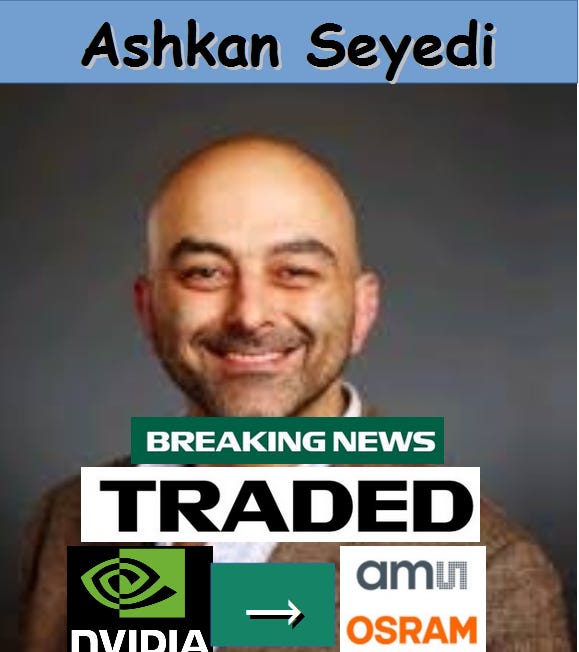
Saalam Ashkan! Mobarak!
Contents:
CPO vs NPO: For Dummy Supply-Chain Degenerates
Re-affirming Lumentum Superior UHP Laser
VCSEL CPO: The Ashkan Arc
Jihad Against Jim Anderson
[1] CPO vs NPO: For Dummy Supply-Chain Degenerates
A lot of idiots who understand nothing on the engineering of advanced optics (CPO, NPO) are spouting bullshit while blindly re-gurgitation Taiwan rumor mill.
To be clear, CPO and NPO are conceptually very similar. NPO has worse power efficiency and worse channel density. But the underlying tech is very similar.
TSMC seems to have botched their high-density 2D grating couplers. That issue, alongside delayed SiN PDK development has given a temporary advantage to Tower Semi. Nvidia moved their program from TSMC to Tower and everyone who actually follows this space properly knew 6+ months ago.
The downside of a Tower-based NPO solution is twofold.
Lower channel density. (need more wavelengths)
Worse power efficiency
#1 is because of longer electrical channel with more reflections (bump capacitance is killer) requiring strong electrical SerDes. More EQ and more complex driver.
#2 is because of the previously mentioned items + exponential laser power and noise requirements. To compensate for fewer channels, modulation speed has to go up. This means SNR requirements go up and laser burden also goes up.
There exists a sweet-spot for datarate of a CPO system between 32G and 64G NRZ. Personally I prefer 64G NRZ but there are arguments for any datarate in that range.
Too slow and your heater power explodes. Too fast and the laser power + SerDes power explodes. These are not linear penalties.
Nvidia has decided to temporarily move away from TSMC COUPE. This is because TSMC has dragged their feet on SiN and (more importantly) botched 2-D grating couplers.
Plan-A was slow-and-wide (~50-64G NRZ) 8-wavelength DWDM on TSMC COUPE CPO .
Plan-B is 200/400G PAM4 on 16-wavenlgth DWDM on Tower SiPho NPO.
Everyone who follows this space properly knew this 6 months ago. The entities who blindly peddle Taiwan leaks with zero understanding of the underlying technology have been spreading panic derived from their own incompetence.
At higher modulation rate, the noise requirements (RIN, linewidth) of the laser go way up.
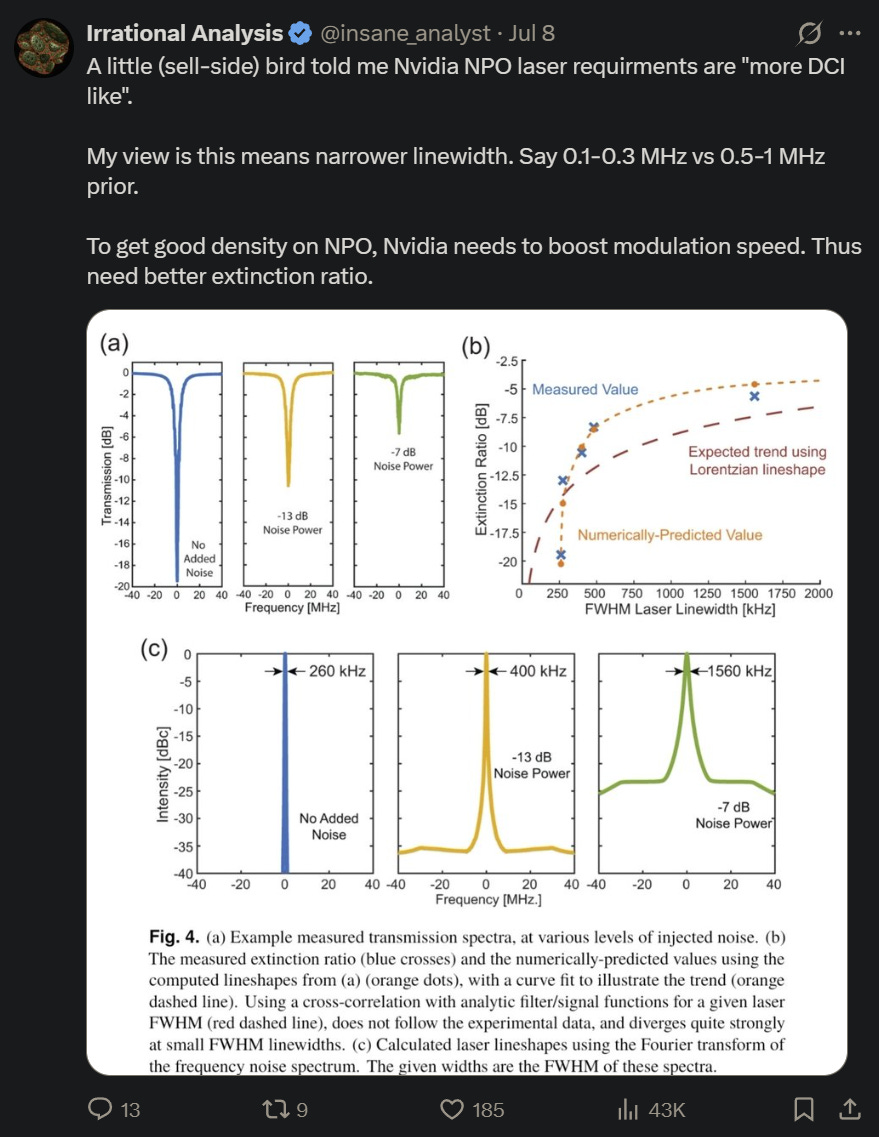
Laser linewidth murders the extinction ratio of ring modulators.
This means longer cavity length, bigger InP chip, and new (higher price) SKU for Lumentum. Absolutely fucking nobody other than Lumentum and Broadcom can meet the laser specs needed for Nvidia NPO. Retards, LITE 0.00%↑ content goes way up with Nvidia moving from CPO to NPO. Reality is the opposite of what you pod monkeys think.
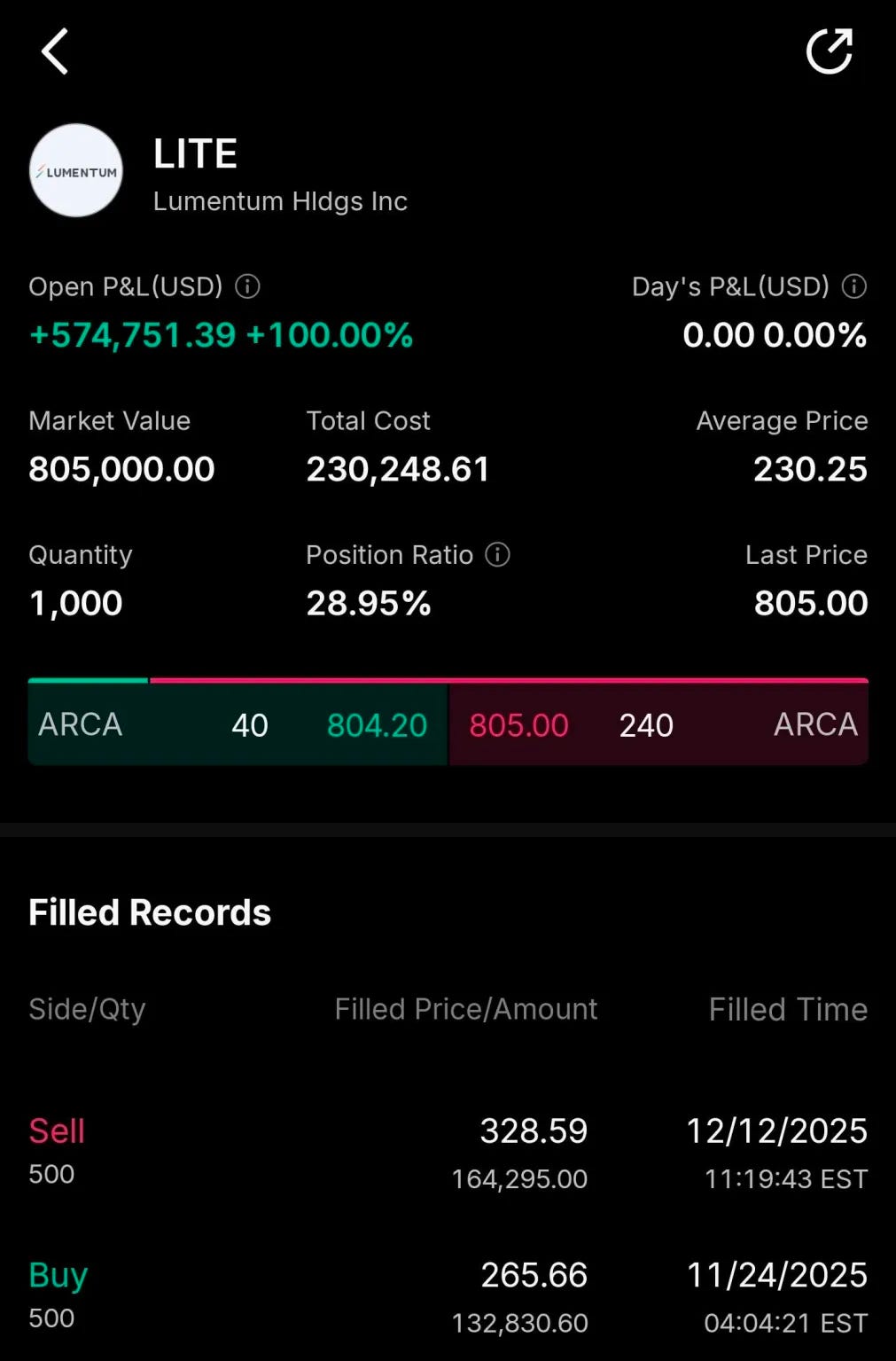
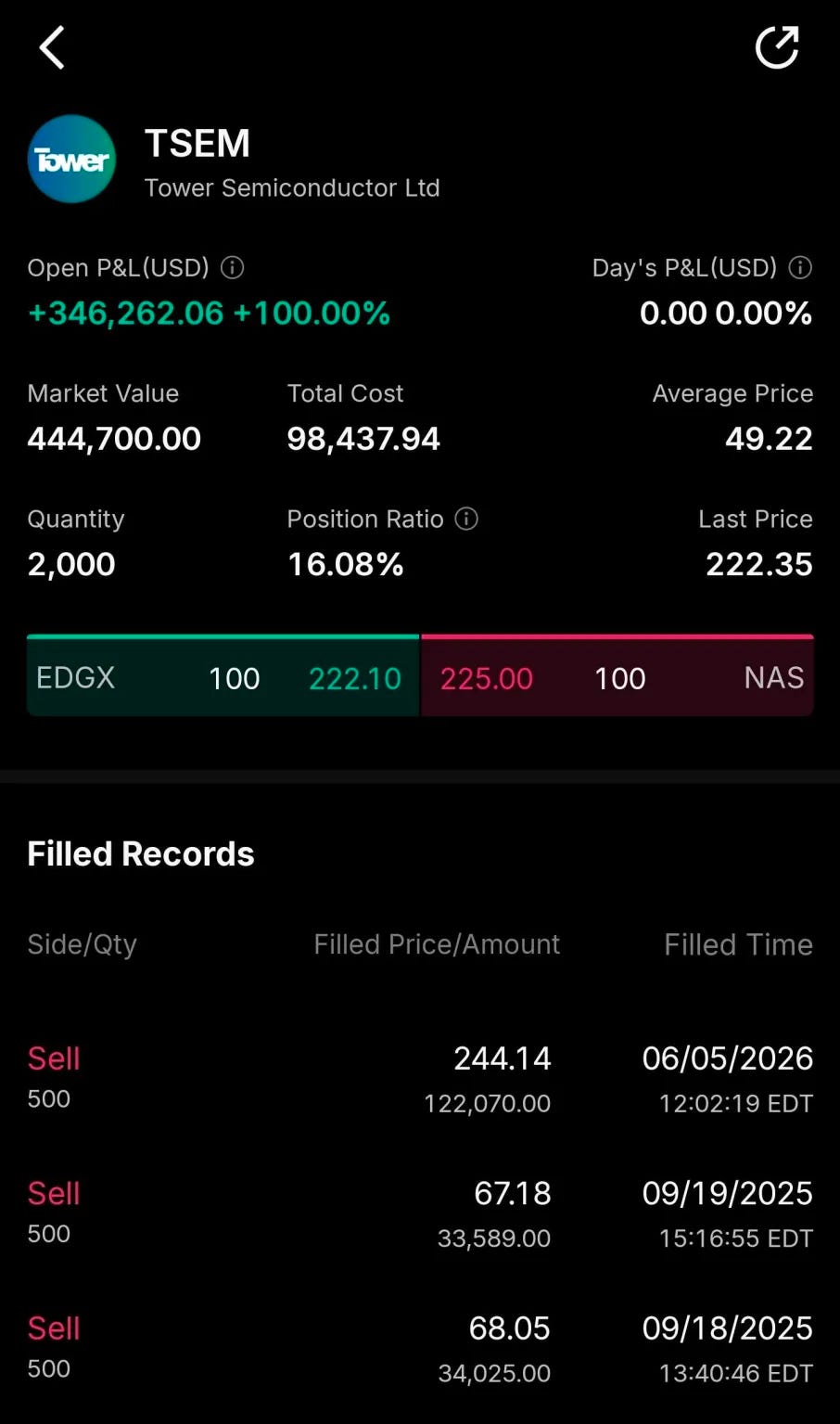
You can see I trimmed Tower for risk management reasons but not a single share of Lumentum was sold this year. I dare every institutional investor reading this to short Lumentum. Free market will decide who is right, me (engineering-driven investment analysis) or the fools who parrot Taiwan leaks using ClaudeChatGPT.
[2] Re-affirming Lumentum Superior UHP Laser
The data is public. Only Lumentum’s data mind you. Everyone else is a coward who wont publish proper information outside of NDA.
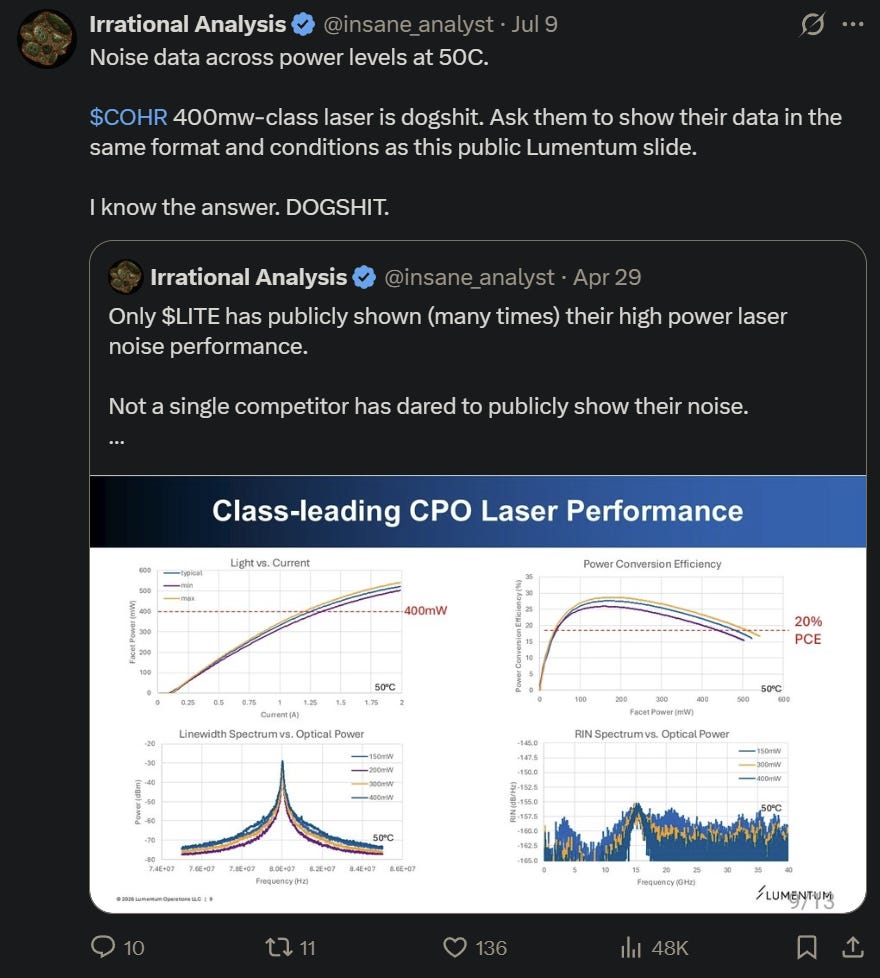
Lasers can hit a wide range of power levels depending on the temperature. For example, Lumentum’s UHP (ultra-high-power) laser is officially rated for 350mW of output power with a soft cap at 400 mW. You can run it at 450mW but reliability becomes questionable and wall-plug-efficiency (WPE) AKA power conversion efficiency suffers.
The output power and efficiency depends strongly on temperature. Higher temperature means less power and worse efficiency. Most people choose to operate the hot-side of the TEC (thermo-electric-cooler) at 50C and the cold-side at 40C. This provides a good balance between system-level thermal efficiency and laser performance. At OFC 2026, Lumentum’s demo was at 30C cold-side TEC setpoint to make themselves look better. I am telling you 40C is the correct (reasonable/realistic) comparison point.
Lumentum also shows public noise data across output power. Nobody else has done this. There is a reason for this.
I would like every single buy-side and sell-side analyst to print out the above Lumentum slide and request Coherent to share the same data in the same format under the same test conditions.
I know the answers. No need to send me your notes.
Coherent has failed in the UHP laser market. They know they have failed. This is provable given their roadmap.
There are two ways of making a high-power laser.
Make big laser.
MOPA
MOPA stands for main-oscillator power-amplifier. Essentially it is a smaller 100mW laser feeding into an amplifier all on the same InP chip.
The benefit is the noise of the final output depends on the smaller 100mW laser and is thus much easier to manage.
The drawback is the monolithic InP chip is much larger and there is significant mode-hop (flickering/instability) risk due to the cavity between the DFB and the SOA.
Furukawa already has a MOPA for UHP market. Coherent is working on it as a pivot given how dogshit their existing 400 mW laser is.
Lumentum and Broadcom are running circles around literally everyone else. There is no Chinese competition. I dont give a fuck what the rumors about JY 300mW DFB are. Show me the linewidth. Show me the cavity length. Show me the WPE curve.
Jim Anderson is bluffing. He has nothing until the MOPA is ready next year and even then it might fail due to mode hops.
[3] VCSEL CPO: The Ashkan Arc
Ashkan Seyedi is a very important person. If you worked in optics world, you know who this guy is. He previously was the head of Nvidia optics before Jensen poached Ling Liao from Intel to take over. Ling and Ashkan are both very smart but Ling is sharper IMO.
Within Nvidia, there were two factions. Team ring-modulator (Santa Clara) and team VCSEL CPO (Isreal/Mellanox). Team ring-modulator won last year. Ashkan was a part of team ring. Go look at his academic paper publishing history.
https://scholar.google.com/citations?hl=en&user=TVhiqXwAAAAJ&view_op=list_works&sortby=pubdate
His PhD was on GaAs nanowire photodiodes arrays (for micro-LED systems) and all his recent work is on ring-modulator DWDM. Ashkan is a vocal hater of micro-LED.
So when this Nvidia hot-shot defected to a dying euro-poor LED shitco, every optics tourist immediately assumed he has become a micro-LED supporter.

Fundamentally what you need to understand is micro-LED and VCSEL CPO/NPO are conceptually very similar. The key delta is max datarate.
LEDs are limited to 2-5 GHz bandwidth, with a (very generous) cap around 10 GHz is the LED people come up with something groundbreaking.
VCSELs meanwhile can hit 50-70GHz bandwidth without issue.
Optics people often ignore electrical reality. I don’t give a damn how nice your shitty LEDs are. Having a huge number of lanes and single-digit GHz will result in disastrous EMI and crosstalk. It won’t work without a super-heavy FEC on all the hundreds of fucking lanes. Anyone with a basic system-level understanding realizes this immediately.
VCSEL CPO/NPO is literally what micro-LED wishes it could be. Objectively better in every way except cost.
Yes, micro-LED is cheaper. It also does not and never will work at scale so who the fuck cares.
AMS OSRAM is a dying company. They have both LED and VCSEL but in reality most of their business is LED. That existing business (LED lighting) has been annihilated by the Chinese.
What you have to understand is VCSEL CPO/NPO quality depends on the quality of the packaging, integrated drivers, manufacturing, and yield of the system. The VCSEL quality itself is not that important. Many can make a 32-64G NRZ VCSEL.
Broadcom is the king of VCSEL. Coherent has very good VCSEL. In fact, Coherent’s VCSEL NPO demo at OFC 2026 was excellent.
Lumentum, Furukawa, and many others also have good VCSEL.
My gut feeling is Ashkan saw something in AMS OSRAM historical LED packaging expertise and decided this was his chance to make VCSEL CPO/NPO work at scale. He is very smart. He knows something. I am certain.
They have a packaging/integration ace up their sleeves. Something to take meh internal VCSELS and make a real NPO/CPO solution that can credibly compete with SiPho DWDM rings.
[4] Jihad Against Jim Anderson
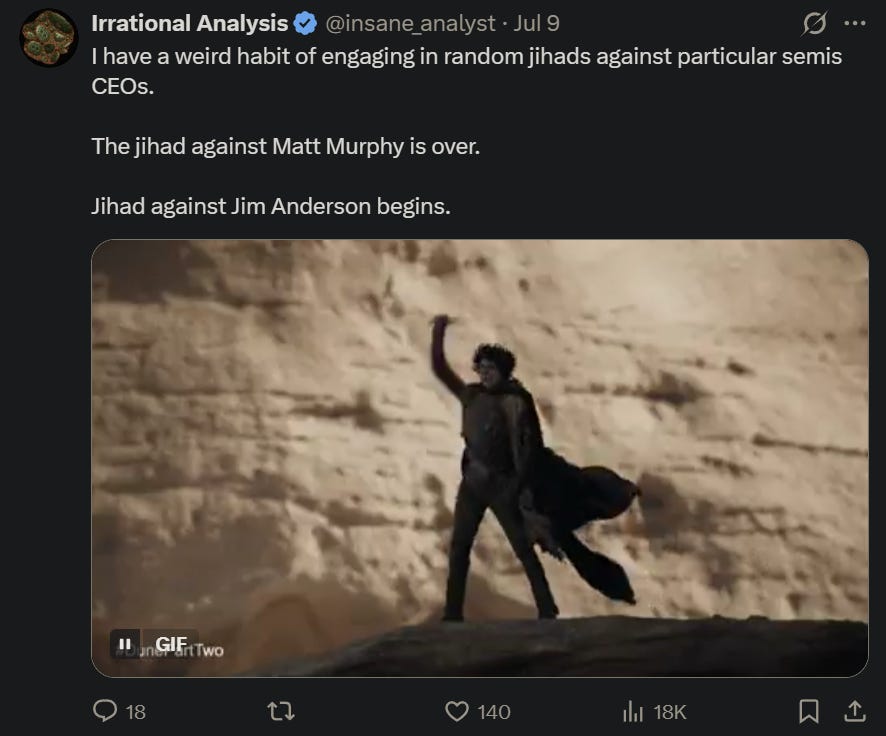
I am not short COHR 0.00%↑.
It’s just I don’t like their CEO.
Trash talking semis CEOs amuses me.
A particular moment in the last earnings call highlights why I do not like Jim Anderson.
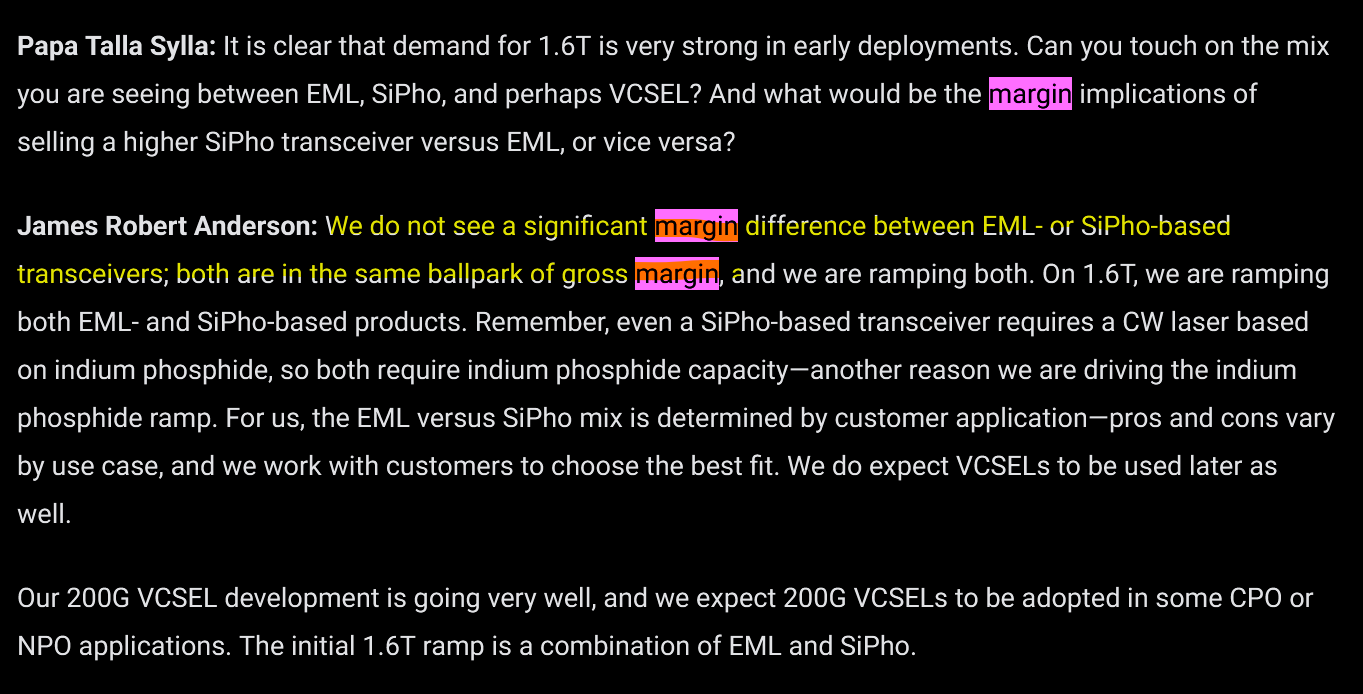
The entire point of SiPho transceiver over EML is to sacrifice modulation performance in favor of saving money by reducing InP content. Historically, every datarate transition (100G to 400G to 800G to 1.6T) resulted in the same pattern. EML first because it has the best performance. Then 6-18 months later SiPho transceivers show up (usually from the Chinese) that are good enough performance but meaningfully cheaper.
This market is different. InP shortage is so fucked, SiPho took majority share much earlier.
THE GROSS MARGINS OF EML BASED AND SIPHO BASED TRANCEIVERS SHOULD NOT BE THE SAME. SOMETHING IS VERY WRONG. EITHER LUMENTUM IS OBLITERATING YOU BY SPIKING EML PRICES CAUSE YOUR 6-IN INP PROCESS IS BROKEN OR YOUR ACTIVE ALIGNMNET YIELD OF SIPHO TRANCEIVERS IS HORRENDUS. OR MAYBE BOTH.
Jim Andersion has been CEO of Coherent for 2 years and he still lacks a basic understanding of the business he is running.
I’m pretty sure sell-side knows more about the business. That’s why the Citi dude asked the question. He probably has followed optics for many years and knows the gross-margin profile of different types of transceivers.
So when the same dude who does not understand transceiver basics claims he has a viable UHP CW laser for CPO/NPO, yea I don’t fucking believe him.
Print out the Lumentum slide showing detailed data on UHP laser and ask Jim Andersion to share the same data in the same format under the same conditions.
Ask him how GR-468 qualification of 200G VCSEL devices is going.
Ask him why EML and SiPho transceivers have the same gross margin.
Ask him what the relative yield of 200G EML on 3-in and 6-in is.
Ask him what the relative yield of 100/250/400mW CW laser on 3-in and 6-in is.
Hey IA, have you taken a look at SMTC for DFB and other InP lasers? They acquired Emcors assets and look like they want to enter the space (Hiefo.com). Laser quality aside, do you see anything interesting they can do along side their signal integrity business ?
TSMC seems to have botched their high-density 2D grating couplers. ---> Therefore, CORNING launched Glass Bridge.