
AAOI Probably Worth Chasing
Technical extrapolation of earnings call transcript.

Irrational Analysis is heavily invested in the semiconductor industry.
Positions will change over time and are regularly updated.
Opinions are authors own and do not represent past, present, and/or future employers.
All content published on this newsletter is based on public information and independent research conducted since 2011.
This newsletter is not financial advice and readers should always do their own research before investing in any security.
Feel free to contact me via email at: irrational_analysis@proton.me
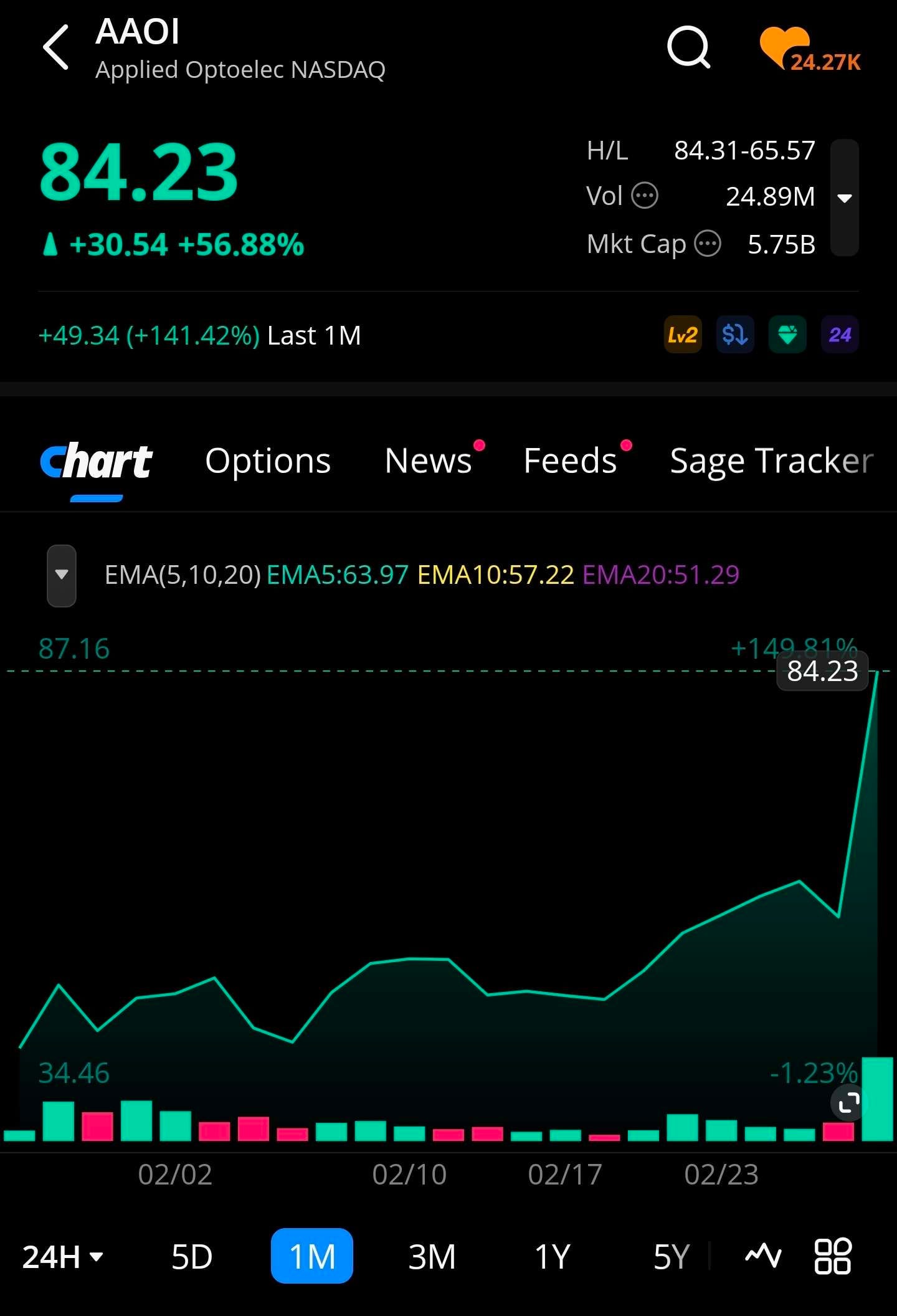
Mildly annoyed that I missed this one…
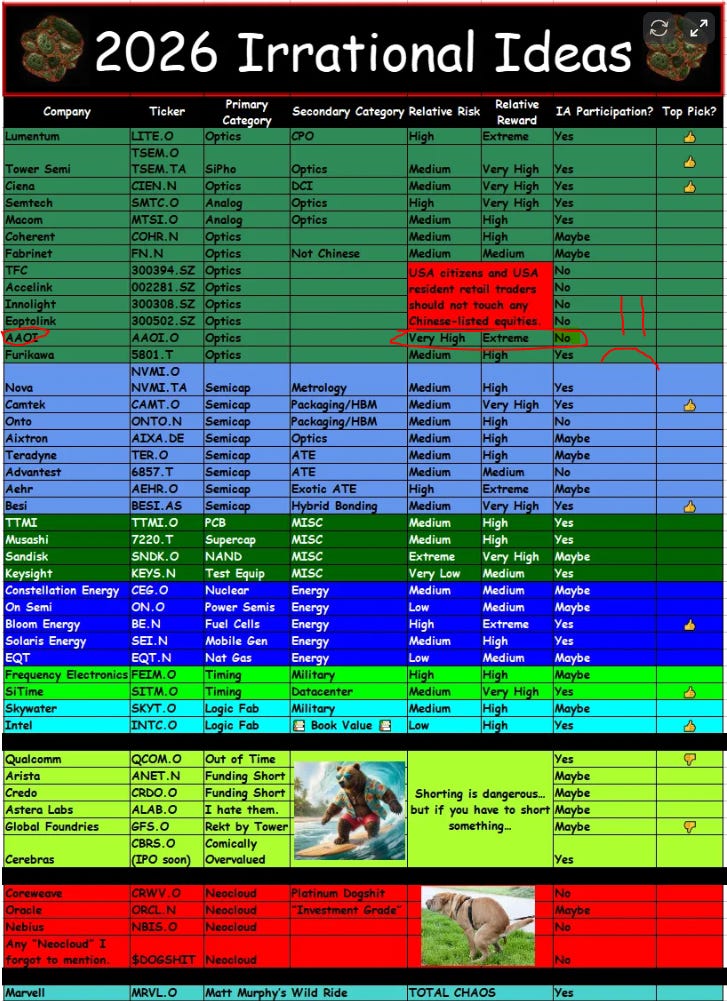
Covered AAOI 0.00%↑ in December and passed on it.
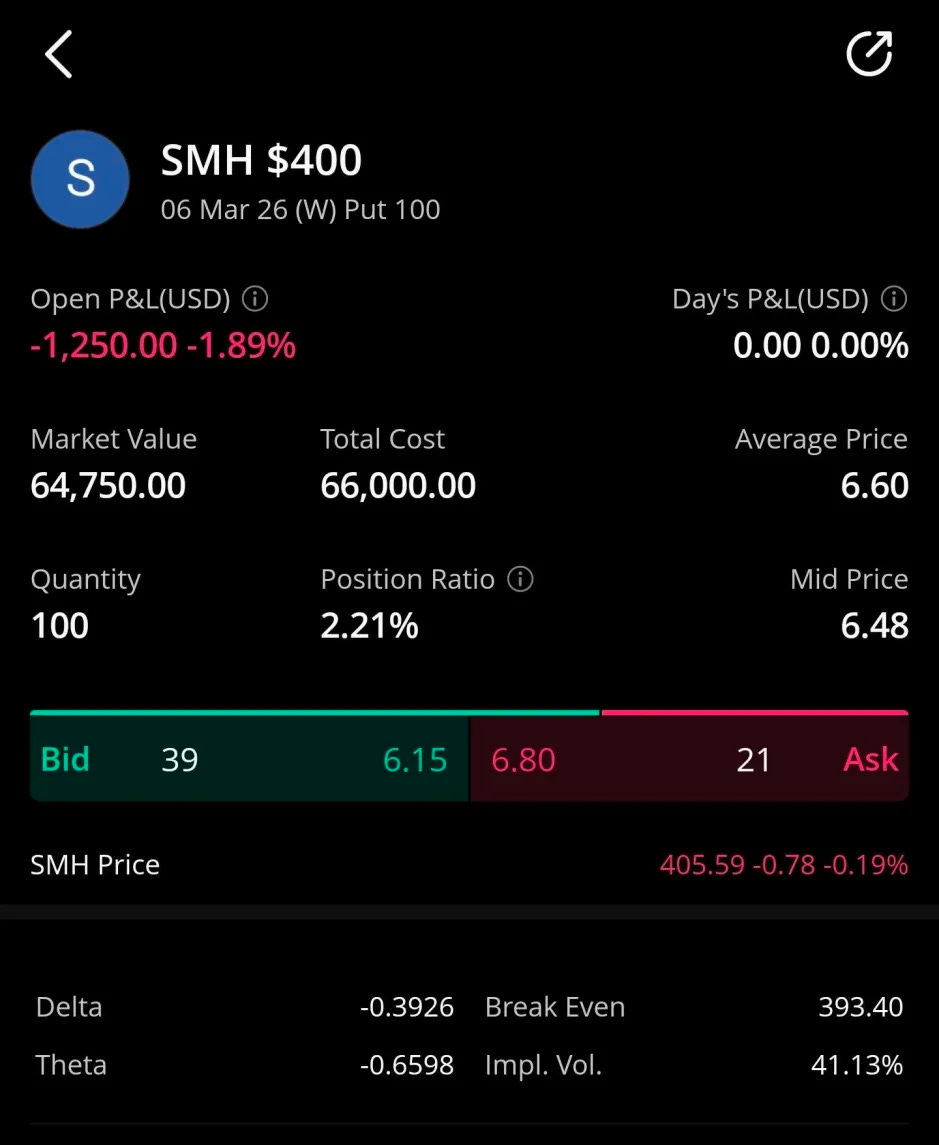
Have some crash puts to hold over the weekend in case Iran shit kills the entire market.
Next week is going to be violent. Assuming I still have buying power after the chaos, ima try and chase AAOI.
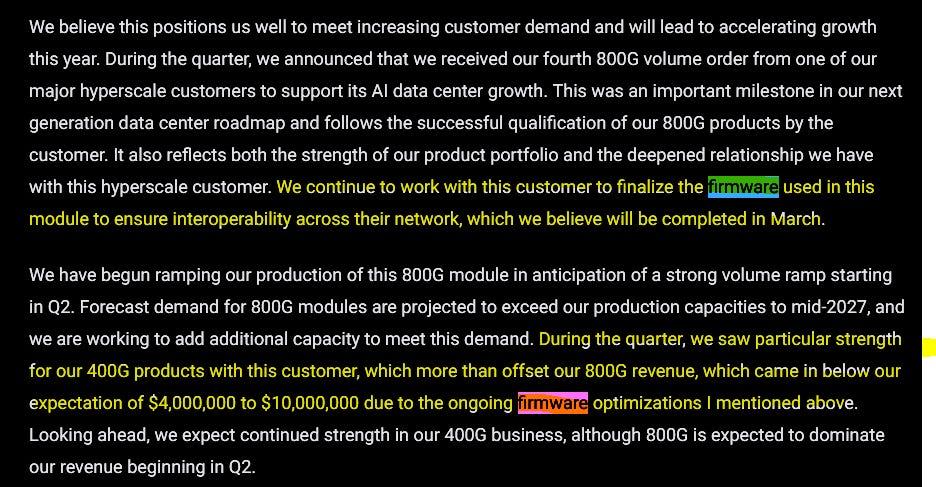
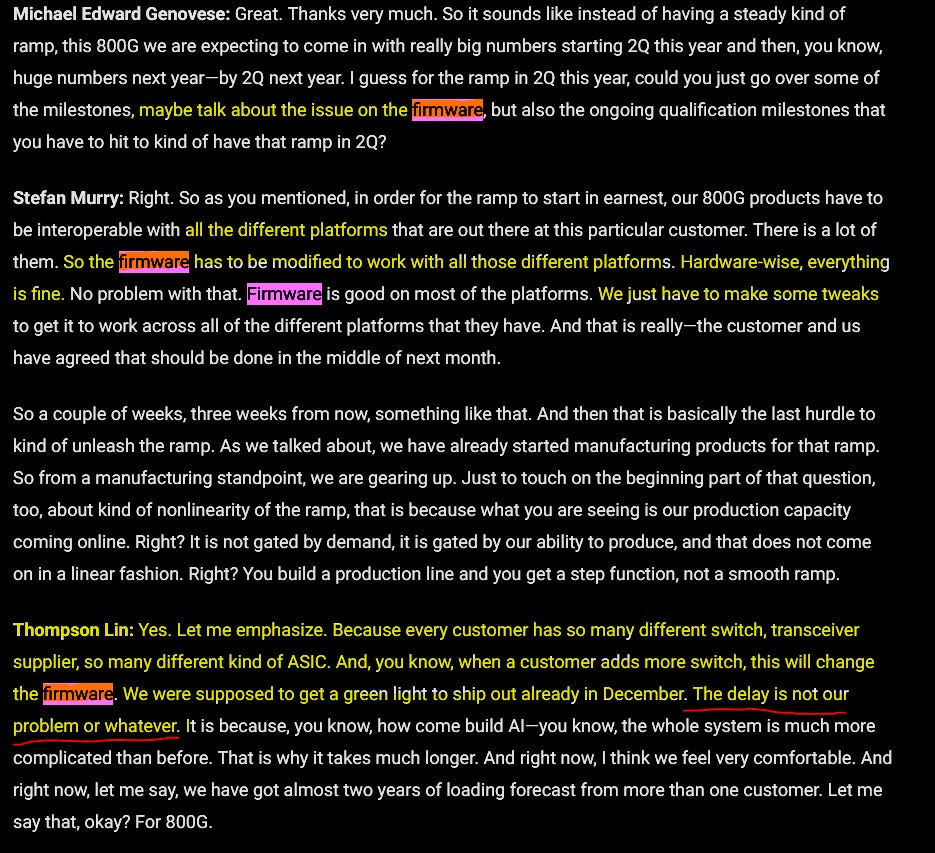
Earnings call has hints as to what is going on. Don’t give a damn about numbers. What matters is where they are in qualification.
For context, AAOI has a horrific reputation. Legendary levels of incompetence. Optical qualification has several parts.
Reliability (GR-468)
Manufacturing line qual.
Interopt
They got the first two finished. The difficult stuff.
Botched interopt but this is easy to fix. I will give you my guess on what they screwed up on in their 800G transceiver firmware in a moment.
This problem came up multiple times in the call.

Let me explain intuitively how interop works in the real world. Here are some relevant snips from official Ethernet standards documentation which governs 2x4x112G (800G) optical transceivers, IEEE 802.3ck.
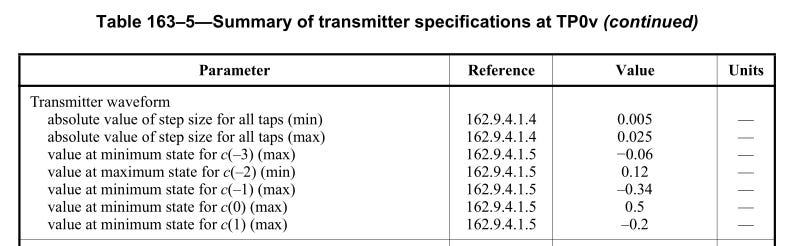
Transmitters are standardized with strict rules. These rules exist to promote interoperability. I say “promote” instead of “ensure” as in real life shit goes wrong frequently.
A standard ethernet transmitter has 5 Tx FIR taps. Standards documents denoted them as c(-3, -2, -1, 0, 1), indicating there are three pre-emphasis taps and one post-emphasis tap.
Those of you familiar with DSP recognize this as a simple FIR filter.
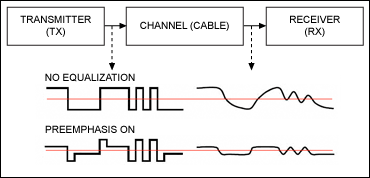
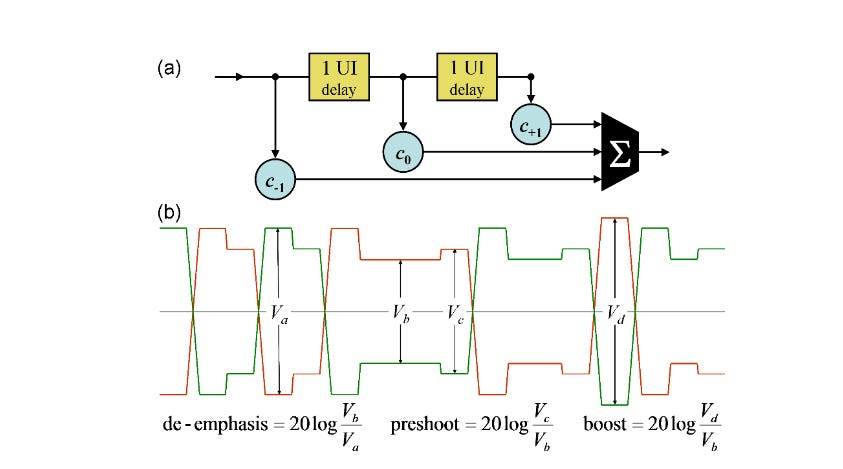
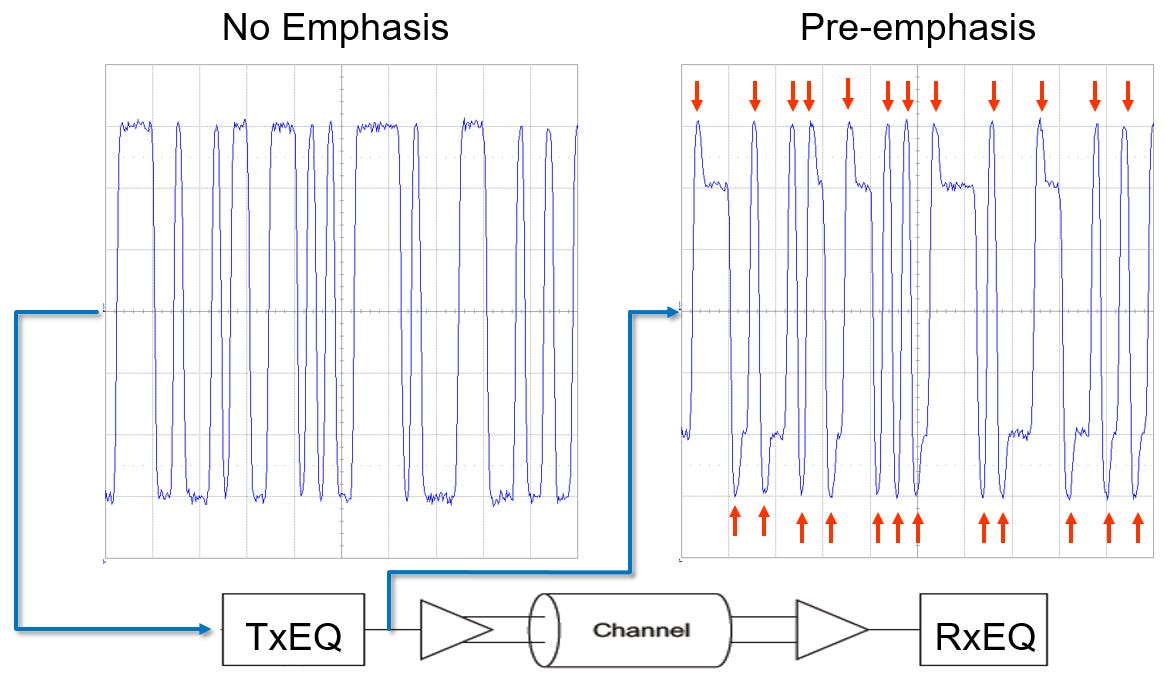
Tx FIR’s job is to pre-distort the signal to account for impairments in the channel.
Main drawback is you lose swing (peak to peak voltage, OMA) if you over-use this strategy.
When you plug in a transceiver, AEC cable, passive DAC cable, whatever, the following procedure roughly happens.
Local Tx (thing you just plugged in) sends out a signal with (0,0,0,1,0)
Remote Rx tries to guess the channel.
Remote Rx requests local Tx to change the Tx FIR, say to something like (0,0,-0.1, 0.9,0)
Repeat until link works.
So let me once again past the standards table now that you understand what the numbers mean.
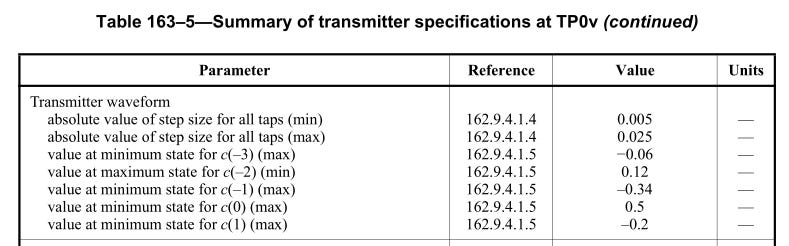
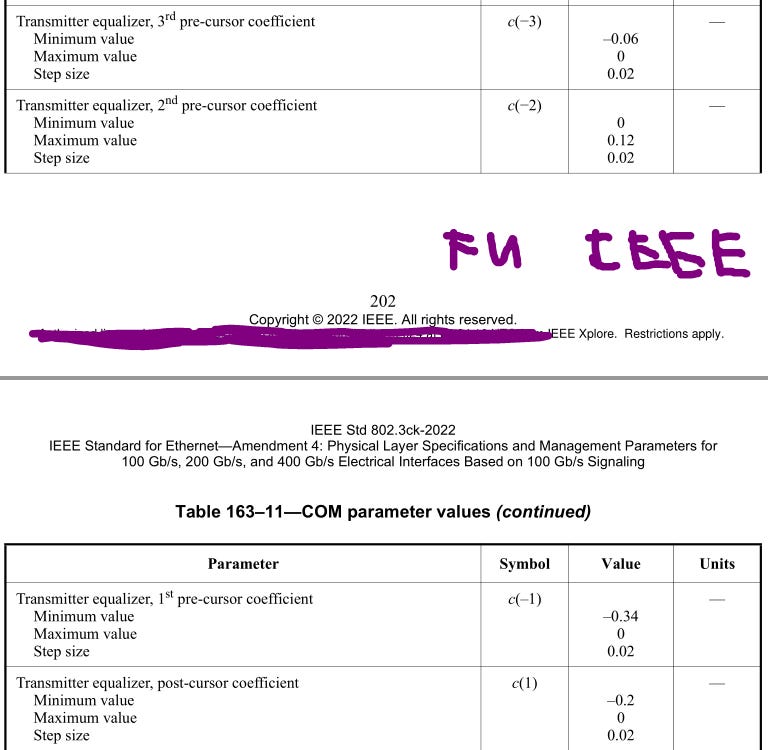
There are hard limits on what values each coefficient can have. For example, setting the post-cursor [ c(1) ] to a value less than -0.2 is illegal. Likewise, a positive post-cursor is also illegal.
Thus, c(1) must be a number between -0.2 and 0, inclusive.
Why? No fucking idea. Vast majority of people who work on this stuff don’t know where these rules come from. Most of the engineers who attend standards meetings also don’t know.
But the rules exist for a reason. Especially the “absolute value of step size for all taps” rule.
Each coefficient needs to have a specific step size across the range. It’s best to explain this with an example.
Suppose I have a variable X that is 7-bit unsigned integer. Thus X can be a value between 0 and 127.
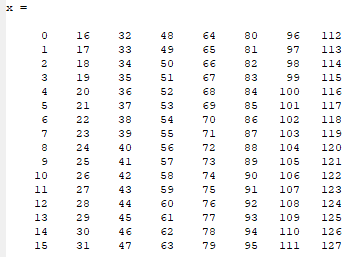
I want to map X to a floating point number that has three decimal accuracy between 0 and 1.
An ideal mapping looks like this.
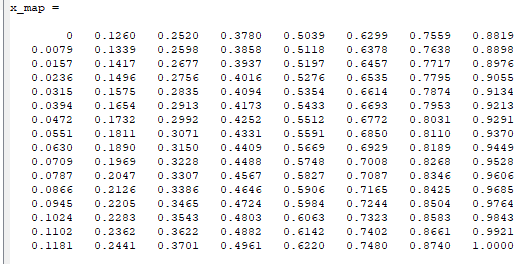
The difference in value between one coefficient and the neighboring one is exactly the same. Always +/- 0.0079.
Now let me mess with some of the values and plot what a bad mapping looks like.
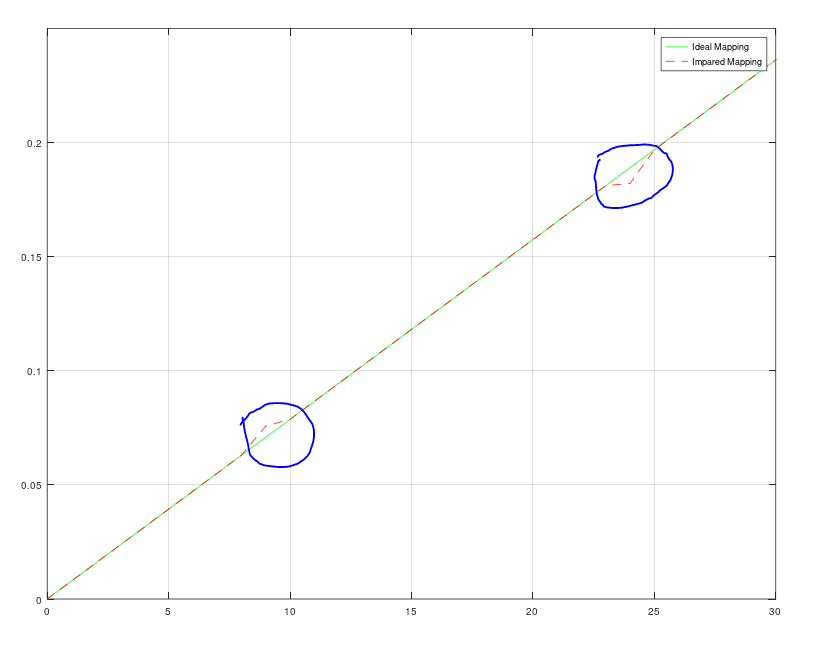
In the real world, circuit nonlinearities and PVT variations lead to Tx FIR coefficient mapping issues. In theory, if the mapping complies with spec (not off by more than what is allowed), things should be fine.
The receiver needs to operate on the expectation that when it requests some Tx FIR, it gets something close to what it wanted and consistent with neighboring combinations.
If Rx requests (0,0,-0.1,0.9,0) but gets (0,-0.025,-0.05,0.9,-0.025) instead, link training will not work and interoperability issues show up.
AAOI CEO explicitly stated that the firmware issue is “not our problem or whatever” which implies that AAOI is complying with spec but for some reason fails interop with some customer equipment. Could be a particular model of switch or version of ASIC.
These things happen all the time. I have seen some weird shit before. Trust me lol.
Receiver design is very open. People can do (almost) whatever they want. A particular SerDes Rx might be fine in one chassis/PCB but have strange problems elsewhere.
TLDR;
AAOI was incompetent for years.
They fixed difficult problems such as optical reliability and manufacturing reliability.
Remaining firmware issue is probably Tx FIR related, not their fault, and a normal problem that happens all the time.
This is worth chasing IMO. AAOI has massive internal InP/laser capacity. Ima try and buy some next week. Sadly, missed the initial move.
/ok-tucano investigate:@tucano.space:stop;
What kind of laser they can produce? How much InP capacity are we talking about?